West Asia Crisis: U.S.-Iran Ceasefire Ends | Key Demands & Peace Talk Updates | Khabar For You
- Khabar Editor
- 21 Apr, 2026
- 89337
Email:-infokhabarforyou@gmail.com
Instagram:-@khabar_for_you

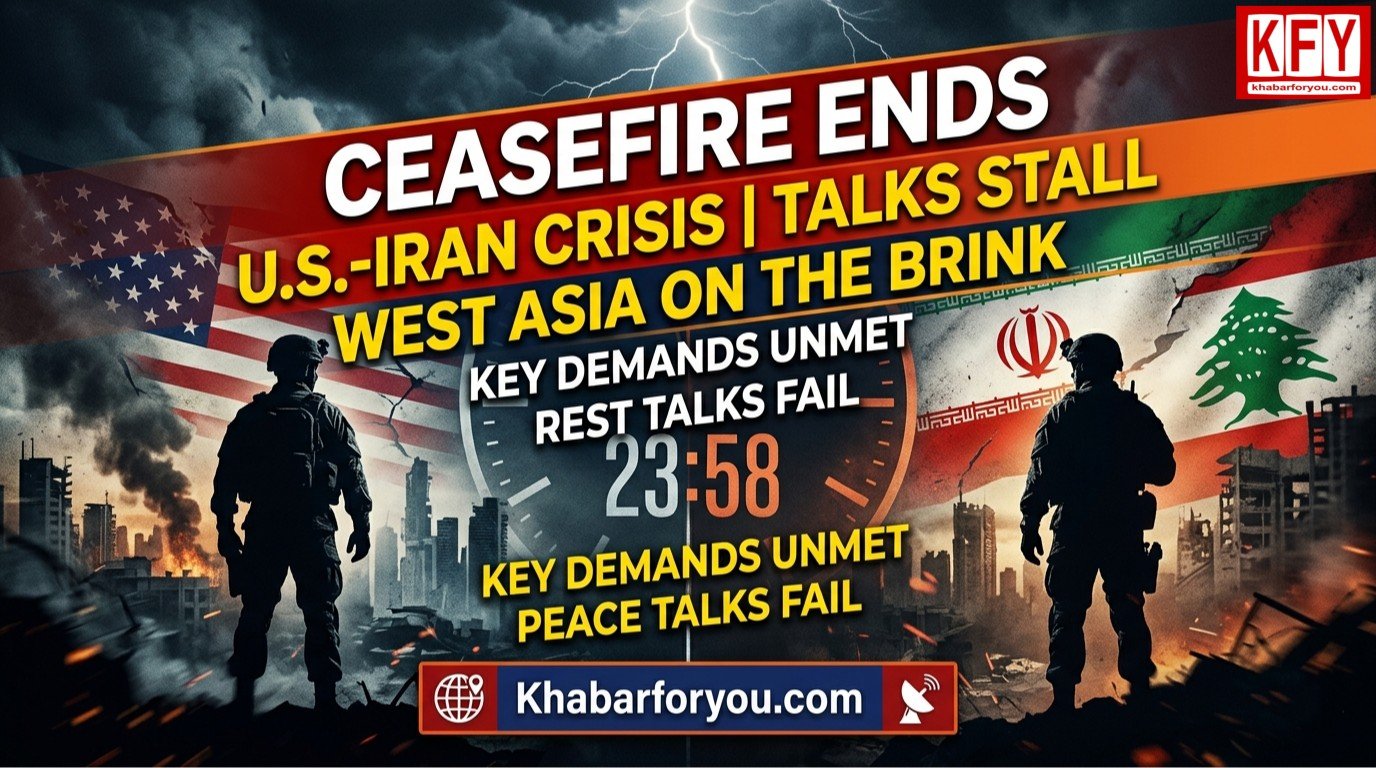
As the sun sets over the Persian Gulf tonight, the world holds its breath. At midnight, the 14-day "fragile" ceasefire between the United States and the Islamic Republic of Iran is set to expire, leaving the Middle East suspended between a historic diplomatic breakthrough and a catastrophic return to all-out war.
What was hailed by U.S. Vice President J.D. Vance on April 8 as a "necessary pause" now looks more like a tactical breather. While Islamabad remains the epicenter of frantic "shuttle diplomacy," the ground reality in Lebanon and the waters of the Strait of Hormuz suggest that the drumbeats of war are louder than the whispers of peace.
Read More - Delhi Census 2027: Exclusive Report on Digital Door-to-Door Surveys & Privacy Concerns
The Islamabad Standoff: Negotiating with a Loaded Gun
In the high-security "Red Zone" of Islamabad, Pakistani mediators have spent the last 48 hours in grueling sessions. However, the optimism expressed by President Donald Trump - who recently claimed on Truth Social that a deal was "very close" and that Iran had agreed to "almost everything" - has been sharply countered by Tehran.
Iranian Foreign Ministry spokesperson Esmaeil Baghaei today confirmed that Tehran has "no plans" to send negotiators for the final round of talks. "The U.S. has violated the ceasefire from the beginning," Baghaei stated, citing the continued U.S. naval blockade of Iranian ports and the recent seizure of an Iranian container ship by the U.S. Navy.
The Sticking Points:
Nuclear Sovereignty: The U.S. demands the total transfer of Iran’s highly enriched uranium (HEU) stockpile. Iran’s Parliament Speaker, Mohammad Bagher Ghalibaf, has called this a "surrender demand" that violates national dignity.
The Hormuz Toll: In a radical shift, Iran has proposed a 10-point plan that includes charging "transit fees" for ships passing through the Strait of Hormuz - a move the White House has flatly rejected as "piracy disguised as policy."
The 'Lebanon Link': Perhaps the most volatile issue is the "linked ceasefire." Iran insists any deal must include an immediate cessation of Israeli strikes in Lebanon. Washington maintains the Lebanon-Israel conflict is a "separate theater."
Lebanon: The Ceasefire That Wasn't
While the U.S. and Iran have avoided direct missile exchanges for 14 days, Lebanon has become a gruesome loophole. Despite a 10-day "parallel" truce announced on April 16, the Lebanese Army has reported over 50 violations by the IDF in southern villages.
"The world sees the massacres in Lebanon," Iranian Foreign Minister Abbas Araghchi posted on X (formerly Twitter). Israel, meanwhile, has published maps showing a new "security deployment line" deep inside Lebanese territory, effectively occupying dozens of abandoned villages to prevent Hezbollah from regrouping.
Hezbollah’s stance remains the wildcard. While the group observed a "pause" in attacks on northern Israel initially, recent rocket fire into Nahariya suggests that the "unity of fronts" is being reactivated as the Tehran-Washington deadline looms.
The Trump Doctrine vs. The IRGC Reality
In Washington, the Trump administration’s "Maximum Pressure 2.0" is in full swing. Defense Secretary Pete Hegseth warned that the U.S. would blockade Iranian ports "for as long as it takes" and hinted at a return to "June-style strikes" on nuclear facilities if the midnight deadline passes without a signed framework.
However, intelligence reports suggest the Islamic Revolutionary Guard Corps (IRGC) has used the 14-day window to reconstitute its tactical missile units. While the strategic industrial base of Iran’s missile program has been battered by months of U.S.-Israeli strikes, the operational capacity to "swarming" drone attacks remains intact.
The Global Stakes: Oil and Influence
The economic stakes are staggering. With 20% of global oil passing through the Strait of Hormuz, any resumption of hostilities will likely send crude prices skyrocketing past $150 a barrel.
Pakistan’s Prime Minister Shehbaz Sharif and Army Chief Field Marshal Asim Munir have played the role of the "last bridge." If they fail to bring the two sides to the table in the next six hours, the region faces what analysts call a "forever war" scenario—a conflict that could draw in Gulf neighbors like Saudi Arabia and the UAE, who have already issued warnings about incoming missile threats.
The Verdict
As the clock ticks toward 00:00, the "15 American Demands" remain a wall that Tehran refuses to climb, and the "10 Iranian Points" remain a bridge Washington refuses to cross.
Will the ceasefire be extended at the eleventh hour? Or is the world about to witness the opening of a new, even more violent chapter in the 2026 Iran War? For the people of Beirut, Tehran, and Tel Aviv, the answer arrives at midnight.
Follow Khabarforyou.com for LIVE updates as the ceasefire deadline expires.
© 2023 Khabar For You. All Rights Reserved.
Business, Sports, Lifestyle ,Politics ,Entertainment ,Technology ,National ,World ,Travel ,Editorial and Article में सबसे बड़ी समाचार कहानियों के शीर्ष पर बने रहने के लिए, हमारे subscriber-to-our-newsletter khabarforyou.com पर बॉटम लाइन पर साइन अप करें। |
| यदि आपके या आपके किसी जानने वाले के पास प्रकाशित करने के लिए कोई समाचार है, तो इस हेल्पलाइन पर कॉल करें या व्हाट्सअप करें: 8502024040 |
#KFY #KFYNEWS #KHABARFORYOU #WORLDNEWS
नवीनतम PODCAST सुनें, केवल The FM Yours पर
Click for more trending Khabar
Leave a Reply
Your email address will not be published. Required fields are marked *
Search
Category