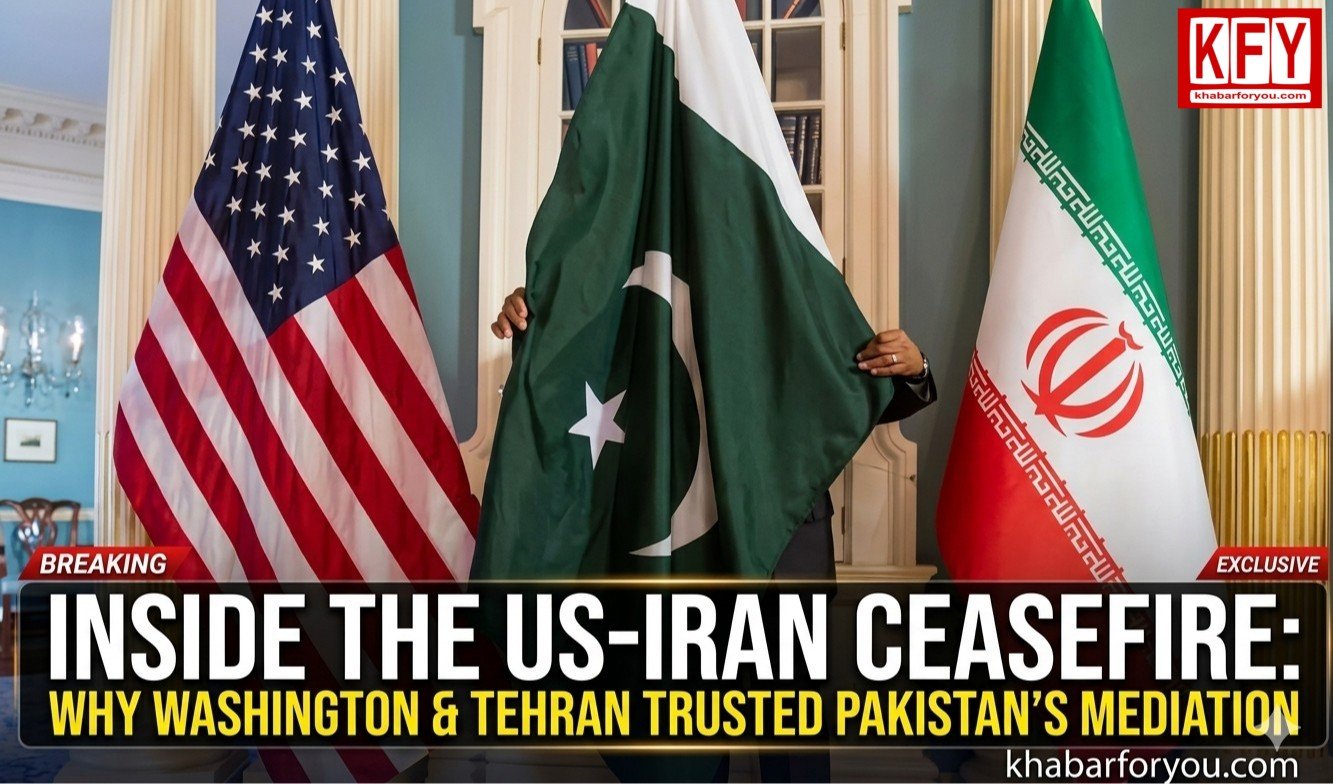
Inside the US-Iran Ceasefire: Why Washington and Tehran Trusted Pakistan’s Mediation | Khabar For You
- Khabar Editor
- 08 Apr, 2026
- 97970
Email:-infokhabarforyou@gmail.com
Instagram:-@khabar_for_you

In the high-stakes theater of Middle Eastern geopolitics, where a single miscalculation can ignite a regional conflagration, an unlikely protagonist has emerged to pull the world back from the edge. As tensions between Washington and Tehran reached a fever pitch last week, threatening to spill over into an all-out "Iran War," it was Pakistan - a nation often embroiled in its own internal domestic and economic crises - that stepped into the breach.
General Asim Munir, Pakistan’s Chief of Army Staff (COAS), found himself at the center of a whirlwind diplomatic effort. While the world watched the movement of carrier strike groups and the enrichment of uranium, a series of "quiet cables" and shuttle diplomacy maneuvers were being executed between Rawalpindi, Tehran, and Washington.
Read More -
The Architect of the Ceasefire
The recent escalation, which saw a series of tit-for-tat strikes across the region, appeared to be the precursor to a broader conflict. However, the announcement of a formal ceasefire came as a surprise to many veteran analysts. The question echoing through the corridors of power in New Delhi, London, and Moscow is: Why did both the United States and Iran trust Pakistan as the sole mediator?
According to high-level diplomatic sources speaking to Khabar For You, the breakthrough was not a product of sudden luck but of a calculated "strategic neutrality" maintained by General Asim Munir. Unlike his predecessors, Munir has navigated the transition of the U.S. administration and the hardline shifts in Tehran with a pragmatic "security-first" approach.
The Washington Connection: A Reliable Backchannel
For the United States, Pakistan remains an indispensable, albeit complicated, partner. Despite the "thaw" in relations over the last decade, the Pentagon maintains deep institutional ties with the Pakistani military establishment.
"The U.S. needed a bridge to Tehran that wasn't a European power," says Dr. Arash Azizi, a regional security analyst. "The Europeans are seen as too aligned with U.S. interests by the Iranians. Pakistan, however, shares a 900-kilometer border with Iran and has a vested interest in preventing a war that would destabilize its own Western frontier."
Washington’s trust in Rawalpindi stems from the "Intelligence Sharing Protocols" that have survived even the lowest points of the U.S.-Pakistan relationship. When the U.S. sought to relay a "non-escalation" guarantee to the Iranian Revolutionary Guard Corps (IRGC), they didn't look to Switzerland; they looked to the Pakistani GHQ.
The Tehran Connection: The Brotherhood of Necessity
On the other side of the divide, Iran’s willingness to sit at the table with Pakistan as a mediator is rooted in historical and religious ties, but more importantly, in shared security threats. Both nations are currently battling a common enemy in the form of separatist insurgents in the Sistan-Baluchestan province.
Tehran views Pakistan as a "sovereign Muslim power" that, while allied with the West, has consistently refused to allow its soil to be used for kinetic operations against Iran. During the peak of the recent crisis, General Munir reportedly assured Tehran that Pakistan’s "neutrality is not passivity," emphasizing that a stable Iran is essential for Pakistan’s "CPEC" (China-Pakistan Economic Corridor) ambitions.
The "Munir Doctrine" in Action
The "Munir Doctrine" - as some Islamabad insiders call it - revolves around the idea that Pakistan’s geography is its greatest leverage. By positioning Pakistan as the "essential stabilizer," Munir has managed to extract diplomatic capital from both sides.
1.The Riyadh Factor: Pakistan’s close ties with Saudi Arabia allowed it to reassure the Gulf monarchies that the US-Iran ceasefire would not come at the expense of Arab security.
2.The Beijing Oversight: China, a major stakeholder in Iranian oil and Pakistani infrastructure, provided the "silent backing" for these talks, preferring a Pakistani-led mediation over a Western-centric one.
The Risks of the High-Wire Act
However, this mediation is not without its critics. Domestically, the Pakistani government faces questions about whether this diplomatic energy is a distraction from the crumbling economy. In Washington, skeptics in Congress remain wary of Pakistan's "double-game" history.
"Trust is a fragile currency in the Middle East," notes an NDTV analyst. "While Pakistan has successfully brokered a ceasefire, the underlying triggers of the Iran-US conflict - the nuclear program and regional proxies - remain untouched. Pakistan has bought the world time, but for how long?"
The View from the Ground: A Fragile Calm
As the ceasefire holds, the border crossings at Taftan remain quiet but tense. For the people of the region, the prospect of an "Iran War" was a nightmare scenario involving massive refugee influxes and economic collapse.
The success of the ceasefire talks has momentarily elevated Pakistan’s stature on the global stage. It has demonstrated that despite internal political turbulence, the country’s military-diplomatic apparatus remains a potent force in international relations.
Conclusion: A New Era of Mediation?
The story of the US-Iran ceasefire is more than just a pause in hostilities; it is a testament to the complex web of dependencies that define modern geopolitics. Pakistan, by leveraging its unique position as a nuclear-armed state with footings in both the Western and Islamic worlds, has proven that it is the only "postman" both Washington and Tehran are willing to receive.
As General Asim Munir prepares for follow-up visits to regional capitals, the world watches with bated breath. The bridge has been built, but the crossing remains perilous. For now, the guns are silent, and the credit, however begrudgingly, is being given to the silent corridors of Rawalpindi.
Business, Sports, Lifestyle ,Politics ,Entertainment ,Technology ,National ,World ,Travel ,Editorial and Article में सबसे बड़ी समाचार कहानियों के शीर्ष पर बने रहने के लिए, हमारे subscriber-to-our-newsletter khabarforyou.com पर बॉटम लाइन पर साइन अप करें। |
| यदि आपके या आपके किसी जानने वाले के पास प्रकाशित करने के लिए कोई समाचार है, तो इस हेल्पलाइन पर कॉल करें या व्हाट्सअप करें: 8502024040 |
#KFY #KFYNEWS #KHABARFORYOU #WORLDNEWS
नवीनतम PODCAST सुनें, केवल The FM Yours पर
Click for more trending Khabar
Leave a Reply
Your email address will not be published. Required fields are marked *
Search
Category