Netanyahu Backs U.S.-Iran Ceasefire: Hezbollah Excluded | KhabarForYou
- Khabar Editor
- 08 Apr, 2026
- 98716
Email:-infokhabarforyou@gmail.com
Instagram:-@khabar_for_you


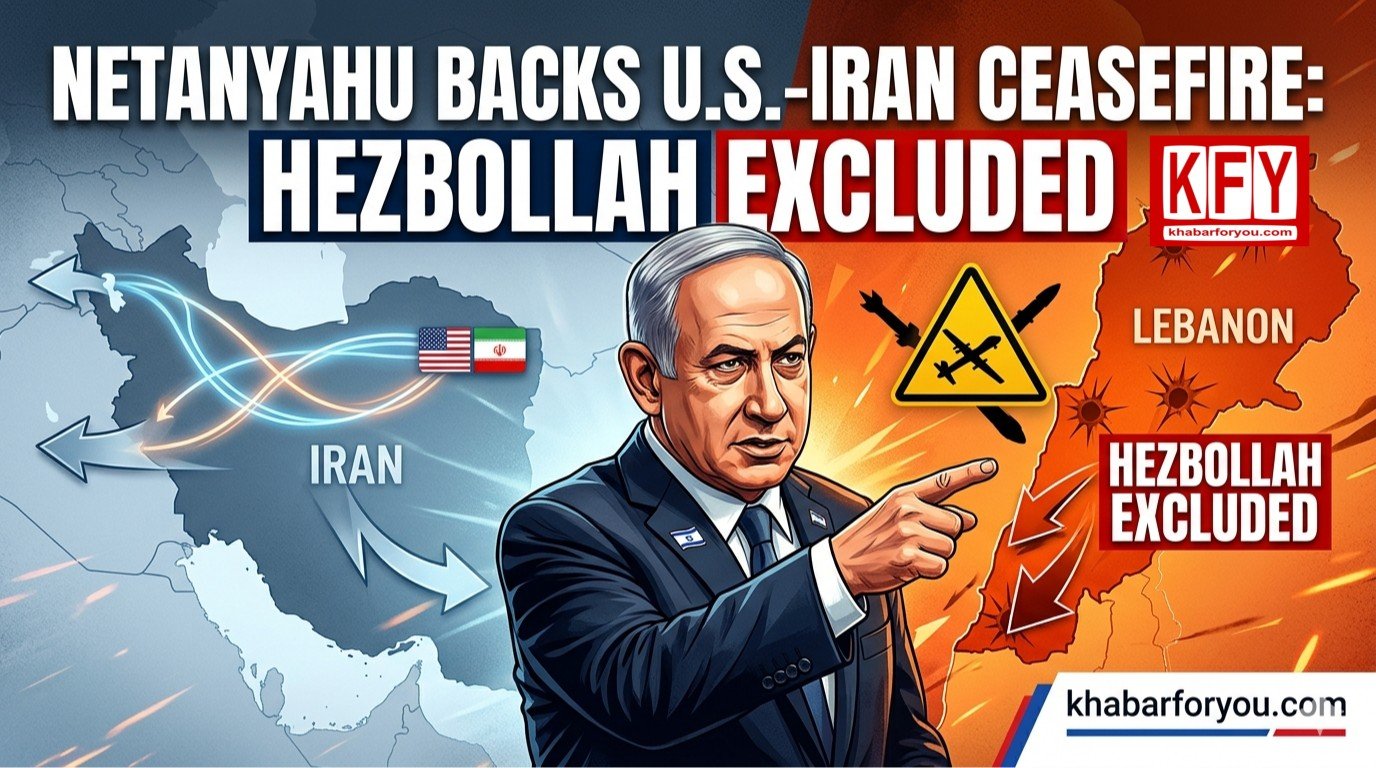
In a diplomatic maneuver that has sent shockwaves across the Middle East and triggered a flurry of high-level consultations in world capitals, Israeli Prime Minister Benjamin Netanyahu has officially signaled his support for a U.S.-led initiative to secure a ceasefire with Iran. However, the Prime Minister coupled this rare endorsement with a stern, non-negotiable caveat: the cessation of hostilities does not, under any circumstances, extend to Lebanon’s Hezbollah.
This dual-track strategy - de-escalating with the patron while intensifying the campaign against the proxy—marks a pivotal, and some say perilous, shift in the regional security architecture. As the world watches, the move raises a fundamental question: Can a "partial peace" hold in a region where the actors are so inextricably linked?
Read More - India’s Nuclear Milestone: Kalpakkam PFBR Achieves Criticality | KhabarForYou
The Washington Consensus: A Fragile Truce
The announcement comes on the heels of marathon negotiations in Geneva and New York. The United States, leading a coalition of Western powers, has been desperate to prevent a full-scale regional war that would inevitably draw in American forces and destabilize global energy markets. The proposed "De-escalation Roadmap" involves a series of reciprocal steps: Iran commits to halting its uranium enrichment at 60% and restraining its maritime interference in the Strait of Hormuz, while the U.S. offers limited sanctions relief and a freeze on further deployment of strategic assets in the Persian Gulf.
Netanyahu’s backing of this deal is, on the surface, a departure from his historically hawkish stance on Tehran. For decades, the Israeli leader has been the foremost critic of any rapprochement with the Islamic Republic. However, sources within the Prime Minister’s Office (PMO) suggest that the shift is pragmatic.
"The Prime Minister recognizes that a direct confrontation with Iran at this moment would stretch the IDF’s resources to a breaking point," a senior Israeli defense official told KhabarForYou.com on condition of anonymity. "By backing the U.S. decision, Israel buys time and diplomatic capital. But it is not a peace of the brave; it is a peace of convenience."
The Lebanon Exception: The Northern Front Ablaze
While the diplomatic language regarding Tehran is uncharacteristically soft, the rhetoric concerning Beirut is razor-sharp. Even as he praised the U.S. diplomatic effort, Netanyahu was clear: "Our hand remains on the trigger in the north. The agreement with Iran does not grant immunity to its servants in Lebanon."
In the hours following the announcement, the Israel Defense Forces (IDF) launched a series of "preventative strikes" on Hezbollah's precision-missile manufacturing sites in the Bekaa Valley. Netanyahu’s logic is simple but brutal: he seeks to decouple the proxy from the patron. By neutralizing Hezbollah, Israel hopes to eliminate the immediate threat to its northern Galilee region without triggering a direct Iranian response that would violate the new U.S.-brokered truce.
However, analysts warn that this "Lebanon Exception" may be a bridge too far. Hezbollah is not merely an Iranian tool; it is a central pillar of Iran’s "Axis of Resistance."
The View from Beirut and Tehran
In Beirut, the mood is one of defiant anxiety. Hezbollah Secretary-General Hassan Nasrallah, in a televised address from an undisclosed location, dismissed Netanyahu’s distinction. "The resistance is a single body," Nasrallah declared. "If Lebanon is attacked, the entire axis will respond. Netanyahu thinks he can isolate us, but he is trapped in his own illusions."
Tehran’s response has been characteristically opaque. While the Iranian Foreign Ministry welcomed the U.S. decision as a "step toward recognizing Iranian rights," it remained silent on the fate of Hezbollah. For Iran, the ceasefire offers a much-needed economic lifeline. Yet, sacrificing Hezbollah’s operational freedom would be a massive blow to its regional prestige.
The Investigative Lens: What’s Really at Stake?
Investigative findings by KhabarForYou.com suggest that the U.S. decision was not merely a diplomatic choice but a necessity driven by intelligence reports of "imminent regional collapse." Sources within the State Department indicate that the U.S. gave Israel a "green light" to continue its operations against Hezbollah in exchange for Israel not sabotaging the Iran talks.
This "quid pro quo" diplomacy is a high-stakes gamble. If Israel’s strikes in Lebanon result in significant civilian casualties or hit Lebanese state infrastructure, the pressure on Iran to intervene will become domestic and political.
"You cannot have a ceasefire with the brain while you are stabbing the arms," says Dr. Amal Al-Mansour, a regional security analyst. "The nervous system of the Axis of Resistance is too integrated. If Hezbollah feels an existential threat, they will force Iran’s hand, and the U.S.-Iran deal will vanish like smoke."
Internal Pressures: The Netanyahu Factor
Domestically, Netanyahu is walking a tightrope. His right-wing coalition partners have reacted with fury to any talk of a "deal" with Iran. National Security Minister Itamar Ben-Gvir called the support for the U.S. decision a "historic surrender."
By maintaining a hardline stance on Hezbollah, Netanyahu is attempting to appease his base and prevent a collapse of his government. The "Northern Offensive" serves as a political shield, allowing him to appear strong while simultaneously following the U.S. lead on the broader regional stage.
The Global Impact
The international community remains divided. The European Union has cautiously welcomed the de-escalation with Iran, hoping it will lead to a broader dialogue. Conversely, Gulf monarchies - traditionally wary of both Iran and Hezbollah—are watching with deep skepticism. Riyadh and Abu Dhabi are reportedly concerned that a U.S.-Iran deal will simply embolden Iran’s regional meddling, regardless of what happens in Lebanon.
As oil prices fluctuate in response to the headlines, the human cost in southern Lebanon and northern Israel continues to mount. Thousands have been displaced on both sides of the Blue Line, and the specter of a "Limited War" turning into a "Total War" looms large.
Conclusion: A Region on the Edge
The coming weeks will be the ultimate test of this "decoupled" diplomacy. If Netanyahu can successfully degrade Hezbollah’s capabilities without triggering an Iranian intervention, he will have achieved a strategic masterpiece. If, however, the "Lebanon Exception" leads to a multi-front escalation, the U.S.-Iran ceasefire will go down in history as a footnote in a larger tragedy.
For now, the world waits. The drones continue to buzz over the Bekaa Valley, and the diplomats continue to draft statements in Washington. But in the Middle East, peace is often just a brief interval between two wars.
Business, Sports, Lifestyle ,Politics ,Entertainment ,Technology ,National ,World ,Travel ,Editorial and Article में सबसे बड़ी समाचार कहानियों के शीर्ष पर बने रहने के लिए, हमारे subscriber-to-our-newsletter khabarforyou.com पर बॉटम लाइन पर साइन अप करें। |
| यदि आपके या आपके किसी जानने वाले के पास प्रकाशित करने के लिए कोई समाचार है, तो इस हेल्पलाइन पर कॉल करें या व्हाट्सअप करें: 8502024040 |
#KFY #KFYNEWS #KHABARFORYOU #WORLDNEWS
नवीनतम PODCAST सुनें, केवल The FM Yours पर
Click for more trending Khabar
Leave a Reply
Your email address will not be published. Required fields are marked *
Search
Category