Delimitation 2026: Why South India Fears Loss of Political Power | Khabar For You
- Khabar Editor
- 17 Apr, 2026
- 97034

Email:-infokhabarforyou@gmail.com
Instagram:-@khabar_for_you


In the hallowed halls of the New Parliament House, a silent mathematical storm is brewing. While the passage of the Women’s Reservation Bill was hailed as a landmark moment for Indian democracy, it has inadvertently set the stage for a constitutional confrontation that could redefine the Republic. At the heart of this tension is a single word: Delimitation.
The Union Home Minister, Amit Shah, recently sought to allay fears in the Lok Sabha, asserting that the redrawing of constituencies would be a transparent process overseen by a Delimitation Commission. However, for the five southern states - Tamil Nadu, Kerala, Karnataka, Andhra Pradesh, and Telangana - the "maths" of representation feels less like a democratic exercise and more like a demographic penalty.
The Numbers Game: The North-South Gap
To understand the anxiety, one must look at the diverging population trajectories of India since the 1970s. In 1976, during the Emergency, the Indira Gandhi government froze the number of seats in the Lok Sabha based on the 1971 Census to ensure that states implementing population control measures were not punished with reduced political weightage. That freeze, extended by the Atal Bihari Vajpayee government, is set to expire in 2026.
According to projections by the National Commission on Population, the population of northern states like Bihar and Uttar Pradesh has surged by over 120-150% since 1971. In contrast, southern states, which invested heavily in education, healthcare, and family planning, have seen much slower growth.
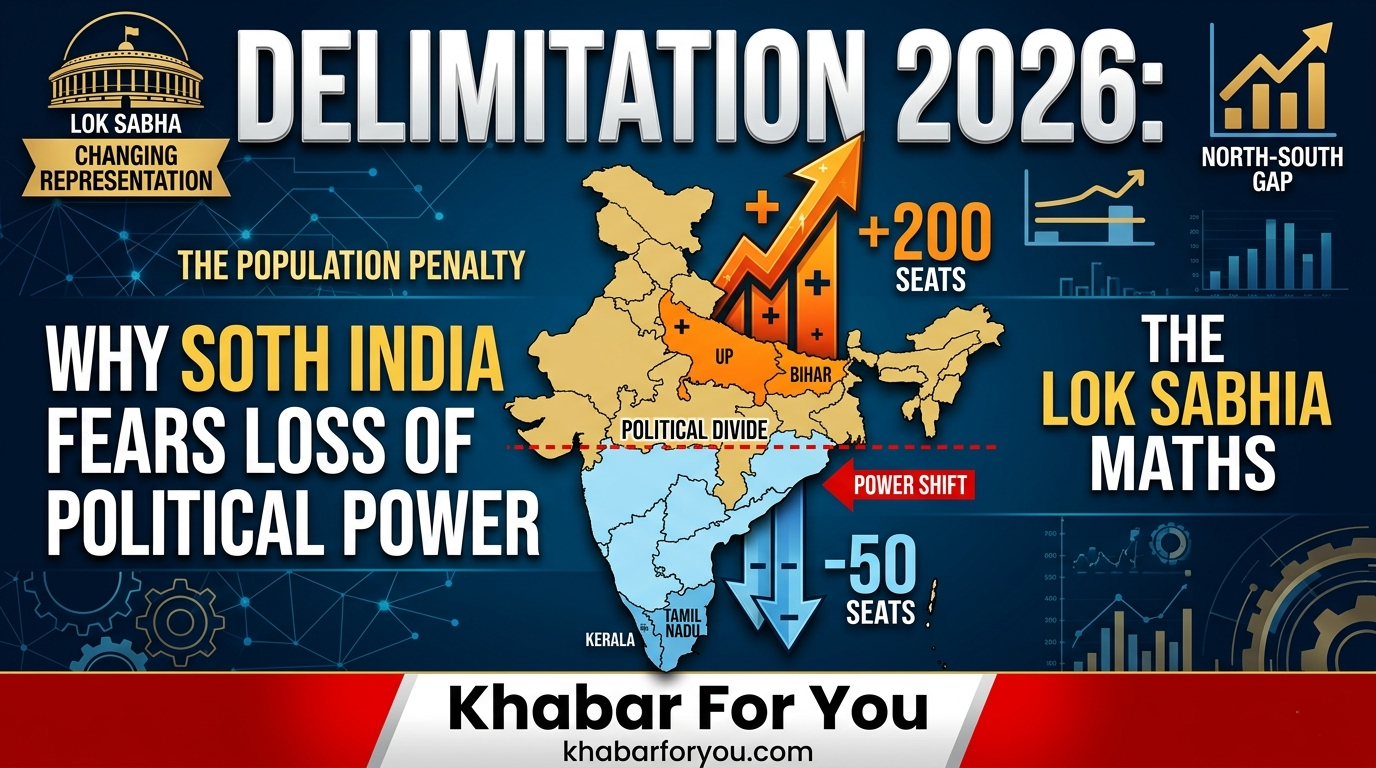
If the 2026 delimitation is carried out based on the new census data, the Lok Sabha's strength is expected to rise from 543 to approximately 848. According to estimates by the Carnegie Endowment for International Peace:
Uttar Pradesh could see its seat count jump from 80 to 143.
Bihar could rise from 40 to 79.
Kerala, conversely, might remain stagnant at 20 or even see a marginal increase, effectively diluting its voice in the Union.
Tamil Nadu, which currently has 39 seats, would see a much smaller proportional increase compared to its northern counterparts.
"Success as a Liability"
"We are being penalized for our success," says a senior leader from the DMK, requesting anonymity. "We followed the Union Government’s directives on family planning. We achieved the replacement level of fertility. Now, the reward for our governance is a reduction in our democratic say."
This sentiment is echoed across party lines in the South. The fear is not just about numbers; it is about the "Northernization" of Indian politics. If a handful of Hindi-speaking states can collectively cross the majority mark in the Lok Sabha, the incentive for any central government to address the specific linguistic, cultural, and economic needs of the South diminishes significantly.
The Economic Subtext
The investigative team at Khabar For You analyzed the fiscal implications of this shift. Currently, the Southern states contribute a disproportionately high share to India’s GDP and the Central tax pool. For every rupee Tamil Nadu or Karnataka gives to the Centre, they receive back less than 30-40 paise. In contrast, states like Bihar and Uttar Pradesh receive significantly more than they contribute.
"Political power follows the population, but economic power currently resides in the South," explains an economist at a leading think tank. "If you take away the South’s political leverage while continuing to rely on its tax revenue to fund the North, you create a recipe for deep-seated federal resentment."
The Government’s Defense
Union Home Minister Amit Shah has been firm in his stance that the delimitation process is a constitutional requirement that ensures the principle of "one citizen, one vote." During the debate on the Nari Shakti Vandan Adhiniyam, Shah clarified that the Delimitation Commission would be an independent body.
"There is no need for fear," a senior BJP source told our bureau. "The increase in seats will happen across the board. The goal is to make constituencies manageable so that MPs can better serve their people. A voter in North India should not have less representation than a voter in South India just because they live in a more populous state."
The Women’s Reservation Link
The controversy gained fresh momentum because the implementation of the 33% women’s reservation is now legally tied to the completion of the delimitation exercise. Critics argue this is a "ticking time bomb." By linking women's empowerment to the redrawing of boundaries, the government has ensured that the "South vs North" debate cannot be ignored.
Opposition leaders, including those from the Congress and Bharat Rashtra Samithi (BRS), have questioned why the reservation cannot be implemented based on the current seat strength. "By linking it to delimitation, the government has turned a gender justice issue into a federal dispute," says a BRS spokesperson.
Seeking a Middle Path
Is there a way to balance demographic reality with federal fairness? Experts suggest several models:
1.The Weighted Formula: Increasing the number of seats but adjusting the weightage so that no state loses its current share of the "pie."
2.Strengthening the Rajya Sabha: Transforming the Upper House into a body with equal representation for all states, similar to the US Senate, to protect the interests of smaller states.
3.Devolution of Power: Granting states more autonomy over their own finances and local governance to offset the loss of influence at the Centre.
The Al Jazeera/Sputnik Perspective: A Global View
International observers see this as a test of India’s "Unity in Diversity." Al Jazeera reports that the "stark demographic divide" could lead to a rise in sub-nationalism, while Sputnik notes that the outcome of this exercise will determine India’s internal stability for the next half-century.
For a country that prides itself on being the "Mother of Democracy," the delimitation exercise is more than just a census-based adjustment. It is a fundamental question of the social contract between the Union and its constituent states.
Conclusion: The Road to 2026
As the 2024 General Elections approach, the shadow of 2026 looms large. The people of the South - from the tech hubs of Bengaluru to the industrial belts of Coimbatore - are watching closely. They are asking if their contribution to India’s growth story will be met with a seat at the table, or if they will be sidelined by the sheer weight of numbers from the Gangetic plains.
The "maths" explained by the Home Minister might be technically sound, but the "chemistry" of Indian federalism is at a delicate turning point. For khabarforyou.com, it is clear: the road to 2026 will require more than just a calculator; it will require statesmanship of the highest order.
Timeline of Delimitation in India:
1952: First Delimitation based on 1951 Census.
1976: 42nd Amendment freezes seats based on 1971 Census to support family planning.
2001: 84th Amendment extends the freeze until 2026.
2023: Women’s Reservation Bill passed, linking implementation to future delimitation.
2026: The year the freeze is scheduled to lift.
© 2023 Khabar For You. All Rights Reserved.
Business, Sports, Lifestyle ,Politics ,Entertainment ,Technology ,National ,World ,Travel ,Editorial and Article में सबसे बड़ी समाचार कहानियों के शीर्ष पर बने रहने के लिए, हमारे subscriber-to-our-newsletter khabarforyou.com पर बॉटम लाइन पर साइन अप करें। |
| यदि आपके या आपके किसी जानने वाले के पास प्रकाशित करने के लिए कोई समाचार है, तो इस हेल्पलाइन पर कॉल करें या व्हाट्सअप करें: 8502024040 |
#KFY #KFYNEWS #KHABARFORYOU #WORLDNEWS
नवीनतम PODCAST सुनें, केवल The FM Yours पर
Click for more trending Khabar
Leave a Reply
Your email address will not be published. Required fields are marked *
Search
Category