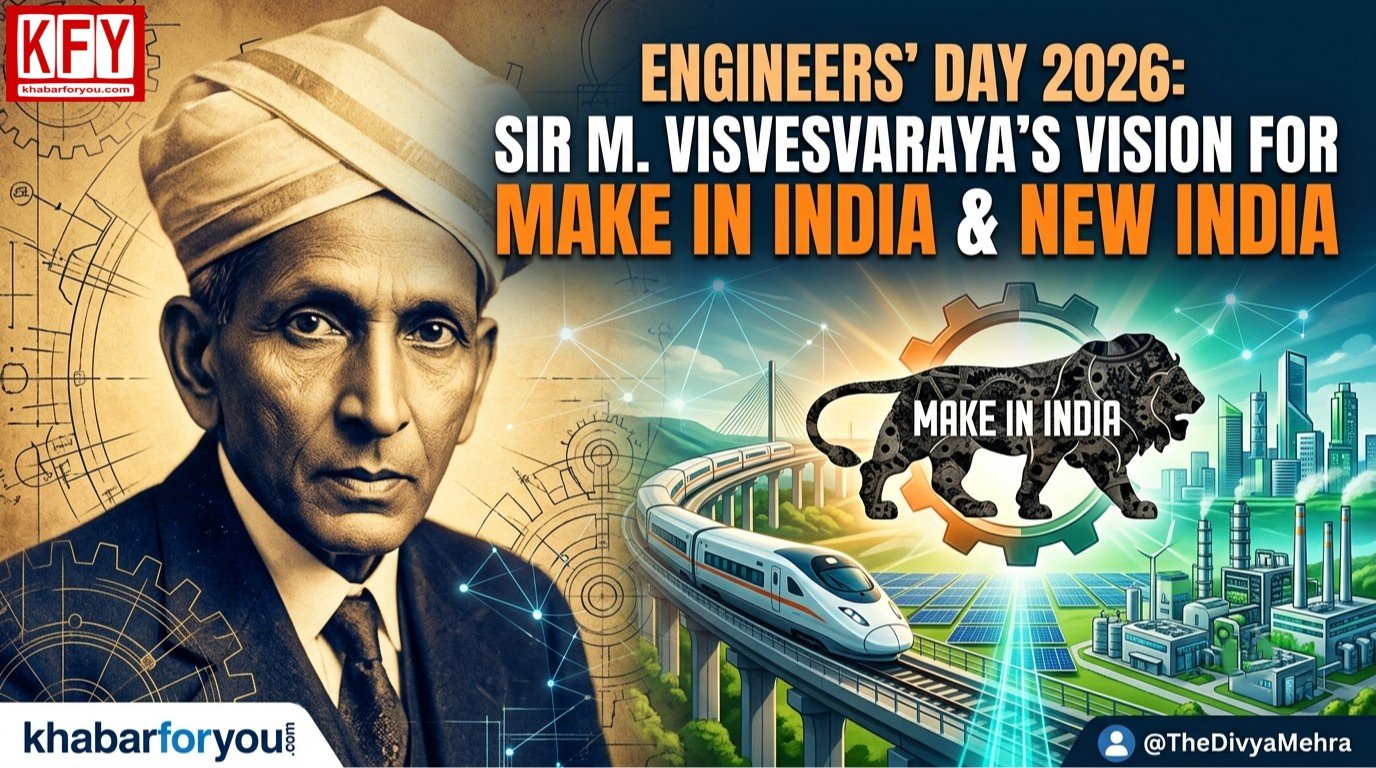
Engineers' Day 2026: Sir M. Visvesvaraya’s Vision for Make in India & New India | KhabarForYou
- DIVYA MOHAN MEHRA
- 15 Sep, 2026
- 93419

Email:-DMM@khabarforyou.com
Instagram:-@thedivyamehra

Every year on September 15, India pauses to observe National Engineers’ Day, marking the birth anniversary of the legendary civil engineer, visionary administrator, and Bharat Ratna recipient, Sir Mokshagundam Visvesvaraya. Popularly known as Sir MV, his birthday is not merely a date on the calendar; it is a reminder of the foundational steel and stone upon which modern India stands.
At a time when the nation accelerates toward its goals of self-reliance, local manufacturing, and futuristic infrastructure, an investigative retrospective into Sir MV’s masterworks reveals an undeniable truth: the ideological framework behind today's "Make in India" and the structural vision driving "New India" were drawn more than a century ago by a man working with a slide rule, a pencil, and an unshakeable belief in self-determination.
Read More - Neem Karoli Baba Mahasamadhi: 11 Sept 1973 Final Moments & Last Words | KhabarForYou (In Hindi And English)
PART I: THE BLUEPRINT OF BHARAT - HOW SIR MV LAID THE PHYSICAL FOUNDATIONS
Born on September 15, 1861, in Muddenahalli, Karnataka, Sir M. Visvesvaraya rose from modest beginnings to become the principal architect of India’s civil and hydraulic infrastructure. His career, spanning public service as an engineer and later as the Diwan of Mysore, redrew the hydrological and economic map of the subcontinent.
Revolutionizing Water Management and Irrigation
Long before automated infrastructure became a global standard, Sir MV changed hydraulic engineering forever. In 1903, he patented and installed automatic weir floodgates at the Khadakwasla reservoir in Pune. These gates, designed to open automatically at maximum water levels without human intervention, raised the storage threshold of the reservoir without compromising the safety of the dam structure - a system later deployed at the Tigra Dam in Gwalior and the Krishna Raja Sagara (KRS) Dam in Mysore.
Equally revolutionary was his implementation of the Block System of Irrigation in the Deccan canals. By rotating water distribution and preventing soil waterlogging, he converted thousands of acres of arid, drought-stricken wasteland into fertile agricultural zones.
Taming Rivers and Preserving Cities
Sir MV’s genius extended far beyond agricultural canals:
The Krishna Raja Sagara Dam (1932): Constructed across the Cauvery River, the KRS Dam was the largest reservoir in Asia at the time of its completion. Built using local *surki* mortar during a severe cement shortage, it eliminated seasonal starvation in the Mandya region and became the lifeline for drinking water and electricity across southern India.
Flood Protection in Hyderabad: Following the devastating Musi River flood of 1908, Sir MV was invited by the Nizam to design a permanent safety network. He devised an urban drainage and storage architecture featuring twin reservoirs - Osman Sagar and Himayat Sagar - which protected Hyderabad from urban flooding for over a century.
Protecting Visakhapatnam Port: He designed complex marine defense systems to prevent severe sea erosion at the Visakhapatnam port, securing a vital maritime gateway for Indian trade.
PART II: THE PIONEER OF MAKE IN INDIA - INDUSTRIALIZING A COLONIAL ECONOMY
While the phrase "Make in India" gained global currency in the 21st century, Sir MV championed indigenous manufacturing when the country was still a British colony restricted to supplying raw materials. He operated on a relentless motto: "Industrialize or Perish."
Establishing Strategic Heavy Industries
As Diwan of Mysore from 1912 to 1918, Sir MV understood that political independence would be meaningless without economic and industrial autonomy. He systematically set up state-backed manufacturing enterprises designed to prove that Indian engineering could meet and exceed global standards:
1. Mysore Iron and Steel Works (Bhadravati): Later renamed Visvesvaraya Iron and Steel Limited, this facility was created to process local iron ore into structural steel, reducing reliance on European imports.
2. Government Soap Factory (1916): Established to utilize indigenous sandalwood oil reserves, creating the iconic Mysore Sandal Soap brand that remains a domestic and export leader a century later.
3. Mysore Paper Mills and Chemical Works: Pioneered industrial-scale processing of natural resources to support regional businesses and educational publishing.
Creating the Financial and Human Capital Ecosystem
Sir MV recognized that an industrial movement cannot survive on factories alone; it requires local financial institutions and technical institutions. To power this ecosystem, he founded the State Bank of Mysore in 1913 to fund domestic startups and public enterprise. To build a skilled workforce, he established the Government Engineering College in Bangalore in 1917 (now the University Visvesvaraya College of Engineering - UVCE) and numerous polytechnic institutes, ensuring a continuous supply of homegrown technical talent.
PART III: THE ANCESTOR OF NEW INDIA - ECONOMIC PLANNING AND MODERN GOVERNANCE
In discussions surrounding "New India" - characterized by digital infrastructure, mega-corridors, and central planning - Sir MV’s intellectual contributions stand out as early blueprints.
The Vision of Planned Development
Decades before independent India established its Planning Commission, Sir MV authored his landmark book, "Planned Economy for India" (1934). In it, he laid out a detailed ten-year economic plan detailing how target-driven industrialization, capital allocation, and rural development could lift millions out of poverty. His methodologies directly influenced India’s post-1947 national development models.
Institutional Engineering and Civic Legacy
Sir MV’s holistic approach to nation-building led to the establishment of key civic and academic bodies that still shape Indian industry today:
The Federation of Indian Chambers of Commerce and Industry (FICCI) & All-India Manufacturers’ Organisation (AIMO): Sir MV was instrumental in organizing Indian business leaders into unified national bodies to lobby for sovereign industrial policies.
The Bangalore Agricultural University and Mysore Chamber of Commerce: Built to connect technical research directly with farm output and commercial trade.
Even in his nineties, Sir MV remained active as a national consultant, advising the Indian government on major projects like the location and structural viability of the Mokama Bridge over the Ganga River in Bihar.
PART IV: THE UNBROKEN LEGACY
When Bharat Ratna Sir M. Visvesvaraya passed away in 1962 at the age of 101, he left behind a nation transformed. His life was defined by absolute personal integrity, discipline, and devotion to duty. Legend records that upon assuming the post of Diwan of Mysore, he asked his family members to pledge never to seek personal or financial favors through his office.
Today, as India constructs expressways, high-speed rail lines, automated water distribution networks, and modern manufacturing hubs, it is executing the vision that Sir MV fought to establish over a century ago.
On this Engineers’ Day, as we celebrate the triumphs of Indian innovation, the message of Sir Mokshagundam Visvesvaraya remains clear: a nation’s strength lies in its capacity to build, innovate, and master its own destiny through disciplined engineering and unyielding self-reliance.
Khabar For You
बिज़नेस | स्पोर्ट्स | लाइफस्टाइल | पॉलिटिक्स | एंटरटेनमेंट | टेक्नोलॉजी | देश और दुनिया की ताजातरीन खबरों के लिए बने रहिए khabarforyou.com के साथ।
ताज़ा अपडेट्स सीधे अपने ईमेल पर पाने के लिए हमारे न्यूज़लेटर को तुरंत सब्सक्राइब करें!
क्या आपके पास भी है कोई खबर या वीडियो?
अगर आपके पास कोई ताज़ा समाचार या जानकारी है, तो हमें तुरंत व्हाट्सएप या कॉल करें: 8502024040
सुनिए नवीनतम PODCAST - केवल The FM Yours पर!
ट्रेंडिंग खबरें पढ़ने के लिए यहां क्लिक करें
#KFY #KFYNews #KhabarForYou #KhabarForYou.com
© 2026 Khabar For You. All Rights Reserved.
Leave a Reply
Your email address will not be published. Required fields are marked *
Search
Category