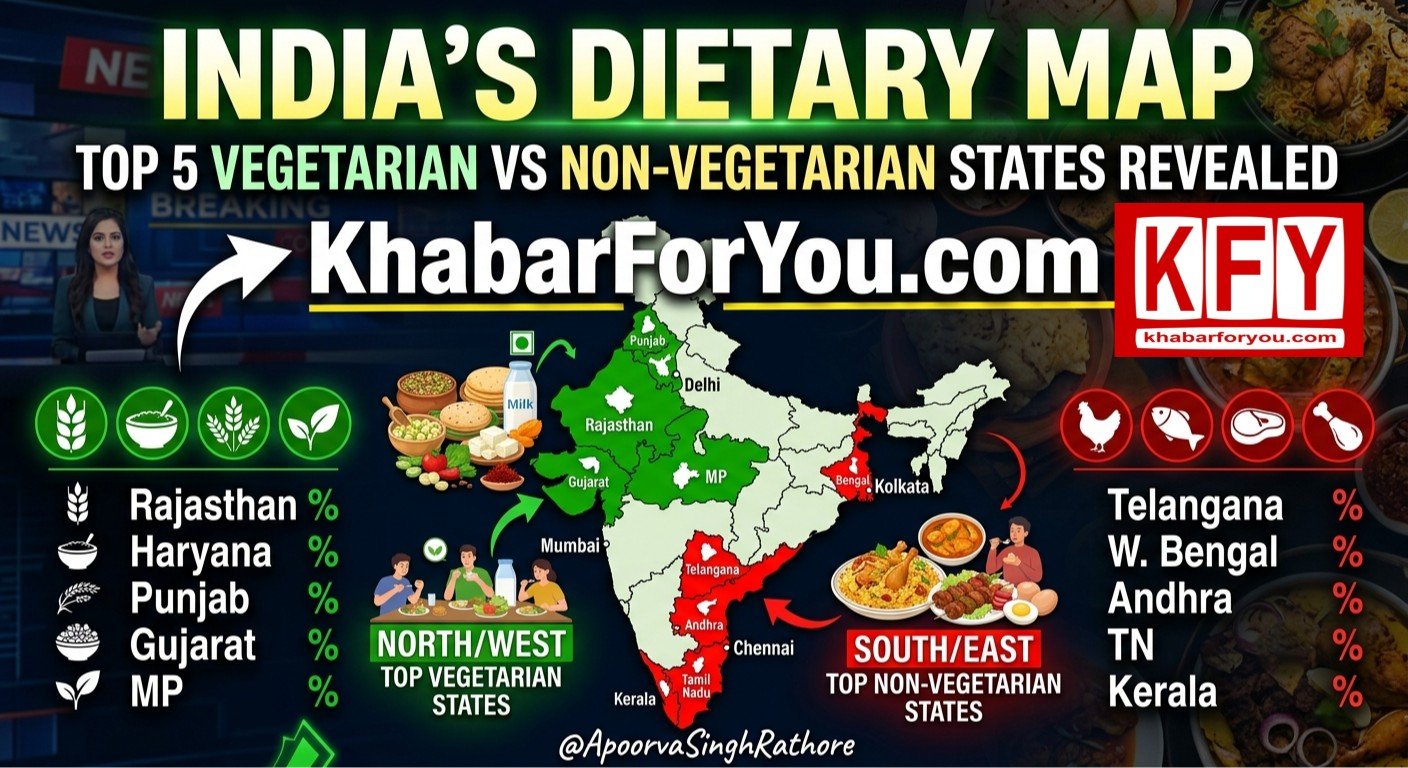
India’s Dietary Map: Top 5 Vegetarian vs Non-Vegetarian States Revealed | KhabarForYou (In Hindi And English)
- APOORVA RATHORE
- 06 Aug, 2026
- 96556
Email:-APOORVASINGHRATHORE@gmail.com
Instagram:-@apoorvasighrathore

Across the vast subcontinent of India, food is far more than mere sustenance - it is a battleground of identity, geography, agrarian history, and socio-economic evolution. For decades, popular discourse, both domestic and global, has often painted India as a overwhelmingly vegetarian nation. However, empirical data from the National Family Health Survey (NFHS-5) and the Sample Registration System (SRS) baseline data reveal a far more nuanced, complex reality: over 70% of Indians aged 15 to 49 consume meat, fish, or eggs in varying frequencies.
Yet, within this diverse demographic canvas lie extreme regional stark contrasts. On one end of the spectrum stand states where vegetarianism remains a deeply entrenched way of life across nearly three-quarters of the citizenry. On the other end are coastal and southern heartlands where non-vegetarianism is virtually universal, exceeding 97% to 99% of the local population.
KhabarForYou investigates the top five vegetarian strongholds and top five non-vegetarian powerhouse states across India, exploring what these culinary boundaries reveal about climate, religion, supply chains, and changing nutritional habits.
Read More - अनुच्छेद 370 निरस्तीकरण के 7 साल: जम्मू-कश्मीर में बदलाव, चुनौतियाँ और विकास | KhabarForYou
Part I: The Vegetarian Belt - Faith, Agrarian Bounty, and Dairy Culture
In the north and northwest corridor of India, vegetarianism is not merely a personal preference; it is a structural norm shaped by centuries of Jainism, Vaishnavism, pastoral traditions, and ready access to high-protein dairy alternatives.
1. Rajasthan: The Epicenter of Plant-Based Living
Rajasthan stands as India’s undisputed capital of vegetarianism, where approximately 75% of the female population and over 63% to 71% of the overall populace refrain from eating meat or eggs.
The desert climate historically limited access to fresh water and livestock grazing land suitable for meat production, giving rise to preserved grains, pulses, and rich milk products. Dishes like *Dal Baati Churma*, *Ker Sangri*, and *Gatte ki Sabzi* highlight how Rajasthani cuisine converted arid limitations into culinary art. Strong roots in Vaishnavite tradition, Marwari business culture, and Jain philosophy further solidify vegetarianism as a social pillar in the state.
2. Haryana: Driven by the Milk Revolution
Clocking in as the second highest vegetarian state, Haryana sees nearly 69% to 80% of its female demographic and over 60% of its total citizens maintaining a strict vegetarian diet.
Haryana’s dietary habits are closely tied to its massive agrarian wealth and dairy output. Known colloquially as the "Land of Milk and Butter," the state substitutes meat proteins with high consumption of paneer, curd, lassi, and ghee derived from robust cattle and Murrah buffalo breeds. For most Haryanvi households, agricultural abundance eliminates the nutritional requirement for meat in the daily diet.
3. Punjab: The Myth of the Everyday Butter Chicken
Despite international perception associating Punjab with tandoori meats and butter chicken, the ground reality captured by government health surveys tells a strikingly different story. Punjab ranks third in vegetarianism, with roughly 55% to 66% of its population adhering to a purely plant-based and dairy-centric diet.
Sikh religious tenets, particularly the institution of *Langar* (community kitchens serving exclusively vegetarian meals), play a major role in shaping public food habits. While meat is eaten socially by a minority, the daily household routine centers around wheat, lentils (*maah di dal*), mustard greens (*sarson da saag*), and buttermilk.
4. Gujarat: Mercantile Ethos and Coastal Paradox
With approximately 54% to 62% of its population identifying as vegetarian, Gujarat secures the fourth spot.
The influence of Jainism, alongside the widespread devotion to Vaishnavism (specifically the Vallabh Sampradaya), has historically defined Gujarati society. Even within commercial urban centers like Ahmedabad and Surat, street food markets remain predominantly vegetarian. What makes Gujarat unique is its long coastline - traditionally a driver for seafood consumption in other states - where cultural and moral norms have maintained a strong preference for plant-based foods like *Dhokla*, *Thepla*, and sweet-salty lentils.
5. Madhya Pradesh: The Heart of Central Vegetarianism
Rounding out the top five is Madhya Pradesh, where between 47% and 50% of the population claims a purely vegetarian lifestyle.
Situated in the heart of the country, Madhya Pradesh acts as a cultural bridge between the strictly vegetarian North-West and the meat-consuming East. Heavy soy and pulse production, combined with large vegetarian agricultural communities, maintains a balanced intake where vegetarian thalis remain the default domestic meal.
Part II: The Non-Vegetarian Powerhouses - Coastal Realities and Cultural Traditions
Moving south and east, the narrative shifts entirely. In these regions, access to vast coastlines, river basins, and historical dietary norms make meat, poultry, and seafood non-negotiable staples of daily life.
1. Telangana: The Non-Vegetarian Capital
Topping national charts as India’s highest meat-consuming state by percentage, Telangana records a staggering 98.8% to 99% non-vegetarian population according to NFHS-5 data.
From the iconic Deccani mutton biryanis of Hyderabad to the spicy poultry curries (*Natu Kodi Kura*) of rural Telangana, meat is deeply woven into the state's social fabric, festive calendar, and daily nutrition. Anthropologists point out that dry land farming historically made poultry and goat rearing more dependable than high-water vegetable crops, establishing meat as the primary protein source.
2. West Bengal: Fish as a Cultural Identity
Standing virtually neck-and-neck with Telangana, West Bengal boasts a 98.5% non-vegetarian demographic.
In Bengal, fish (*Maach*) is not viewed merely as non-vegetarian meat; it is culturally classified as *Joltorongo* (fruit of the water) and features even in traditional ritualistic offerings. The state's fertile Ganges Delta ecosystem provides an endless supply of freshwater fish like Hilsa and Rohu, along with mutton and egg consumption that spans every socio-economic group.
3. Andhra Pradesh: Coastal Abundance and Poultry Powerhouse
With over 98.2% of its populace consuming non-vegetarian food, Andhra Pradesh occupies the third spot.
As one of India’s largest producers of commercial eggs, poultry, and inland aquaculture (shrimp and marine fish), non-vegetarian ingredients are readily accessible and affordable. Seafood along the 974 km coastline and fiery mutton curries in Rayalaseema reflect an environment where vegetarianism is restricted to a minuscule fraction of specific communities.
4. Tamil Nadu: Culinary Diversity Beyond the Tiffin
Despite national stereotypes associating Tamil Nadu exclusively with *Idli*, *Dosa*, and *Sambar*, official data confirms that 97.6% of Tamil Nadu’s population is non-vegetarian.
The state features celebrated regional meat traditions, from the pepper-rich Chettinad chicken and mutton dishes to Madurai’s street-side *Kari Dosa* and coastal seafood fry. Meat consumption spans all socioeconomic spectrums, driven by local livestock farming and coastal fishing hubs.
5. Kerala: The Coconut, Spice, and Coastal Synergy
Rounding off the top five non-vegetarian states is Kerala, where 97.0% of the population regularly eats meat, poultry, or seafood.
Kerala’s unique geographic positioning between the Western Ghats and the Arabian Sea has fostered a food culture centered around beef, pork, poultry, and an extraordinary variety of sea fish. Meals like *Karimeen Pollichathu* (pearl spot fish) and beef fry paired with *Porotta* are eaten across religious boundaries, reflecting a shared regional identity that prioritizes flavor and protein accessibility over dietary taboos.
The Synthesis: What the Numbers Tell Us
The data challenges long-held assumptions about Indian eating habits. Rather than a unified cultural norm, dietary preferences across India are strongly shaped by geographic location, historical agricultural output, and local trade routes.
North-Western states leverage heavy dairy production to support protein needs on plant-based diets. Meanwhile, Southern and Eastern states utilize rivers, oceans, and poultry farming to meet their nutritional requirements. As income levels rise and logistics networks improve nationwide, NFHS trends indicate a gradual increase in overall meat and egg consumption, even as traditional vegetarian strongholds maintain their historic culinary identity.
-------------------------------------------------------------------------------------------------------------------------------------------------------------
भारत केवल सांस्कृतिक विविधताओं का देश नहीं है, बल्कि यहाँ का खान-पान भी राज्य दर राज्य पूरी तरह बदल जाता है। 'नेशनल फैमिली हेल्थ सर्वे' (NFHS-5) और सरकारी आंकड़ों के अनुसार, भारत में लगभग 70% से अधिक आबादी किसी न किसी रूप में मांसाहार (मांस, मछली या अंडे) का सेवन करती है। इसके बावजूद, देश के कई उत्तरी और पश्चिमी राज्यों में शाकाहार की जड़ें बेहद गहरी हैं।
*खबर फॉर यू (KhabarForYou)* की इस विशेष रिपोर्ट में जानिए भारत के टॉप 5 सबसे ज्यादा शाकाहारी और टॉप 5 सबसे ज्यादा मांसाहारी राज्य कौन से हैं और इसके पीछे के मुख्य कारण क्या हैं।
भाग 1: भारत के टॉप 5 सबसे ज्यादा शाकाहारी राज्य
उत्तरी और उत्तर-पश्चिम भारत के राज्यों में जैन, वैष्णव, और डेयरी संस्कृति के प्रभाव के कारण शाकाहार का प्रभुत्व सबसे अधिक है।
1. राजस्थान (Rajasthan)
राजस्थान देश का सबसे बड़ा शाकाहारी राज्य है। यहाँ की लगभग **75% आबादी** पूरी तरह से शाकाहारी है।
कारण: रेगिस्तानी जलवायु के कारण ऐतिहासिक रूप से यहाँ ताजे मांस और पानी की उपलब्धता सीमित थी। इसके विकल्प के रूप में दालों, बाजरे, और डेयरी उत्पादों (दूध, दही, घी) का प्रयोग बढ़ा। 'दाल बाटी चूरमा' और 'केर सांगरी' जैसी डिशेज इसी परंपरा का हिस्सा हैं।
2. हरियाणा (Haryana)
दूध-दही के प्रदेश हरियाणा में लगभग 69% से 80% लोग शुद्ध शाकाहारी खाना पसंद करते हैं।
कारण: हरियाणा में पशुपालन और कृषि की मजबूत परंपरा है। यहाँ मांस के बजाय पनीर, लस्सी, मक्खन और दूध से शारीरिक प्रोटीन की आवश्यकता पूरी की जाती है।
3. पंजाब (Punjab)
बटर चिकन के लिए दुनिया भर में मशहूर पंजाब में जमीनी हकीकत अलग है। पंजाब की लगभग 55% से 66% आबादी शाकाहारी है।
कारण: सिख धर्म में 'लंगर' की परंपरा और वैष्णव प्रभाव के कारण दैनिक जीवन में दाल, साग (सरसों का साग), रोटी और डेयरी उत्पादों का सेवन सबसे अधिक होता है।
4. गुजरात (Gujarat)
व्यापारिक और सांस्कृतिक रूप से समृद्ध गुजरात में लगभग 54% से 62% लोग शाकाहारी हैं।
कारण: जैन धर्म और वैष्णव संप्रदाय का गहरा प्रभाव। अहमदाबाद और सूरत जैसे बड़े शहरों में भी स्ट्रीट फूड मुख्य रूप से शाकाहारी (जैसे ढोकला, थेपला, खाकरा) ही मिलता है।
5. मध्य प्रदेश (Madhya Pradesh)
मध्य भारत का यह राज्य पाँचवें स्थान पर आता है, जहाँ की लगभग 47% से 50% आबादी शाकाहारी है।
कारण: सोयाबीन और दालों का बड़ा उत्पादन क्षेत्र होने के कारण यहाँ शाकाहारी थाली (दाल, चावल, सब्जी, रोटी) ही रोजमर्रा के भोजन का मुख्य हिस्सा है।
भाग 2: भारत के टॉप 5 सबसे ज्यादा मांसाहारी राज्य
तटीय सीमाओं, नदी घाटियों और भौगोलिक स्थितियों के कारण भारत के दक्षिणी और पूर्वी राज्यों में मांसाहार जीवन का अभिन्न अंग है।
1. तेलंगाना (Telangana)
तेलंगाना देश का सबसे बड़ा मांसाहारी राज्य है, जहाँ 98.8% से 99% आबादी मांसाहार का सेवन करती है।
कारण: हैदराबादी बिरयानी और मसालेदार मटन/चिकन क Curry यहाँ की संस्कृति में गहराई से रचे-बसे हैं।
2. पश्चिम बंगाल (West Bengal)
पश्चिम बंगाल दूसरे स्थान पर है, जहाँ लगभग 98.5% लोग मांसाहारी हैं।
कारण: बंगाल में मछली (माछ) को केवल भोजन नहीं, बल्कि सांस्कृतिक पहचान माना जाता है। गंगा डेल्टा क्षेत्र के कारण यहाँ ताजी मछली और चावल मुख्य भोजन है।
3. आंध्र प्रदेश (Andhra Pradesh)
आंध्र प्रदेश में 98.2% आबादी मांसाहारी भोजन करती है।
कारण: लंबी समुद्री तटरेखा (Sea coast) और देश में मुर्गी पालन (Poultry industry) तथा झींगा/मछली पालन का बड़ा केंद्र होना।
4. तमिलनाडु (Tamil Nadu)
आंकड़ों के मुताबिक तमिलनाडु की 97.6% आबादी नॉन-वेज खाती है।
कारण: इडली-डोसा के अलावा, चेट्टिनाड चिकन, मटन सुक्का और तटीय इलाकों का सी-फूड यहाँ के रोजमर्रा के खान-पान का मुख्य हिस्सा है।
5. केरल (Kerala)
पाँचवें स्थान पर केरल है, जहाँ लगभग 97.0% लोग नियमित रूप से मांस, मछली या सी-फूड खाते हैं।
कारण: अरब सागर के किनारे स्थित होने के कारण मछली, बीफ, मटन और चिकन यहाँ के पारंपरिक व्यंजनों (जैसे करीमीन फ्राई, पोरोटा-बीफ) का आधार हैं।
निष्कर्ष (Conclusion)
सरकारी सर्वे के आंकड़े यह स्पष्ट करते हैं कि भारत का खान-पान धर्म से ज्यादा भूगोल (Geography), मौसम (Climate) और उपलब्धता (Availability) पर निर्भर करता है। जहाँ उत्तर-पश्चिम भारत अपनी प्रोटीन की जरूरतें दूध और दालों से पूरी करता है, वहीं दक्षिण और पूर्व भारत मछली, पोल्ट्री और सी-फूड पर निर्भर है।
© 2023 Khabar For You. All Rights Reserved.
Business, Sports, Lifestyle ,Politics ,Entertainment ,Technology ,National ,World ,Travel ,Editorial and Article में सबसे बड़ी समाचार कहानियों के शीर्ष पर बने रहने के लिए, हमारे subscriber-to-our-newsletter khabarforyou.com पर बॉटम लाइन पर साइन अप करें। |
| यदि आपके या आपके किसी जानने वाले के पास प्रकाशित करने के लिए कोई समाचार है, तो इस हेल्पलाइन पर कॉल करें या व्हाट्सअप करें: 8502024040 |
#KFY #KFYNEWS #KHABARFORYOU #WORLDNEWS
नवीनतम PODCAST सुनें, केवल The FM Yours पर
Click for more trending Khabar
Leave a Reply
Your email address will not be published. Required fields are marked *
Search
Category