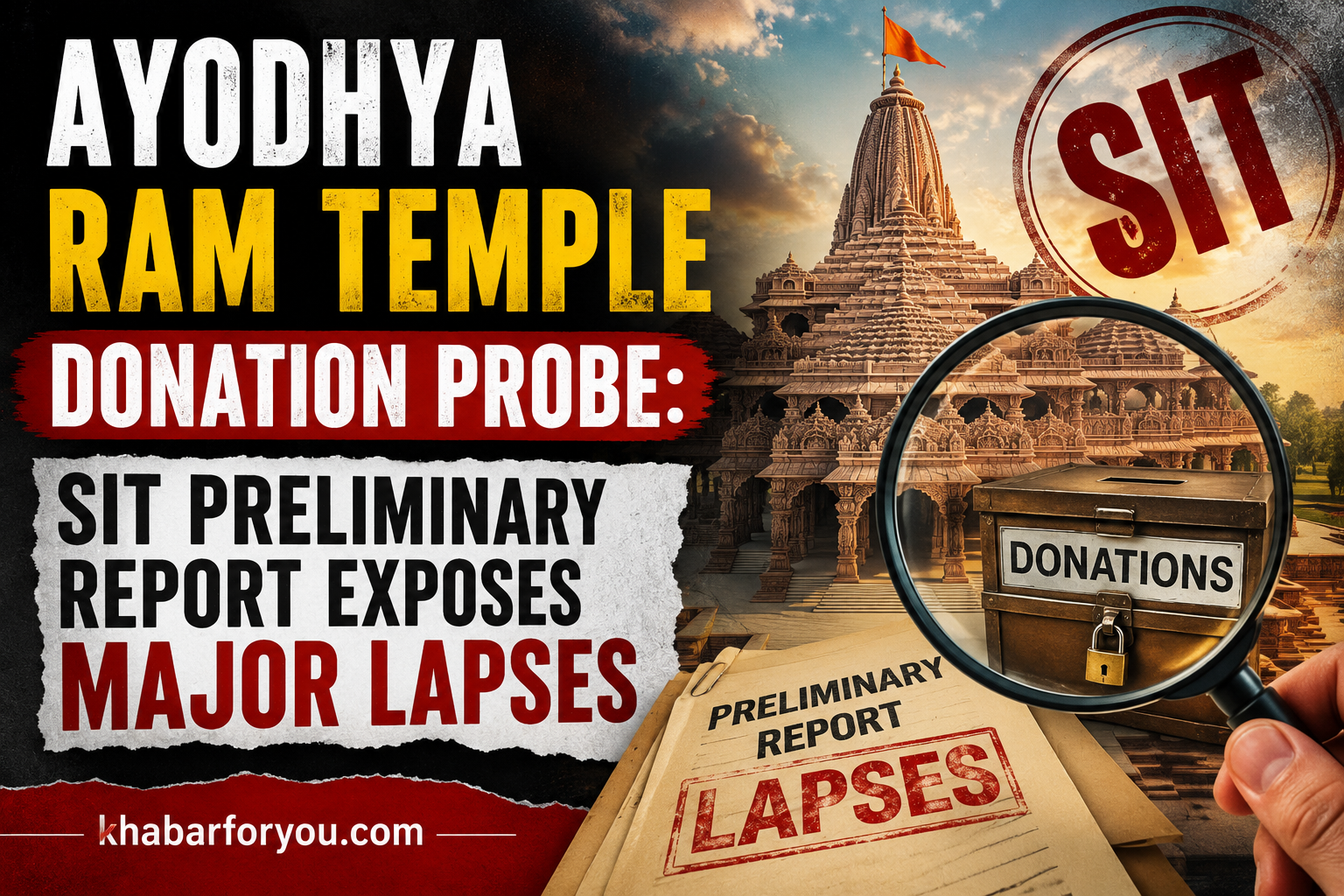
Ayodhya Ram Temple Donation Probe: SIT Preliminary Report Exposes Major Lapses | Khabar For You
- Khabar Editor
- 23 Jun, 2026
- 98268

Email:-infokhabarforyou@gmail.com
Instagram:-@khabar_for_you

When the three-member Special Investigation Team (SIT) led by Lucknow Divisional Commissioner Vijay Vishwas Pant submitted its highly confidential preliminary report to Uttar Pradesh Additional Chief Secretary (Home) Sanjay Prasad on Tuesday, it did more than just hand over a bureaucratic summary. The document marks the first official confirmation of deep procedural and systemic vulnerabilities within the financial administration of India’s most high-profile religious institution: the Shri Ram Janmabhoomi Temple in Ayodhya.
Born out of severe allegations of embezzlement, missing funds, and institutional theft, the state-backed investigation has pulled back the curtain on a convoluted web of manual cash management, compromised surveillance networks, nepotistic hiring, and questionable land procurement deals. For a temple that drew upwards of 10 lakh (one million) devotees daily during the peak Maha Kumbh Mela period in early 2025, the findings point to a structural failure where ancient reverence collided with modern systemic neglect.
Read More - US-Iran Peace Deal Analysis: Where Trump’s War Mandate Fell Short | Khabar For You
The Genesis of the Probe
The controversy erupted into the public domain following intense political sparring and a subsequent formal request by the Shri Ram Janmabhoomi Teerth Kshetra Trust itself to maintain its public integrity. Allegations initially crystallized when former Samajwadi Party (SP) MLA Pawan Pandey claimed that between ₹7 crore and ₹7.5 crore in cash donations had been systematically siphoned away from the temple’s primary collection reserves.
The public outcry intensified after the reported recovery of ₹10 lakh in unaccounted cash from the residence of a temple-associated cash-counting worker, Luv Kush Mishra. Facing immense heat from opposition parties—most notably SP Chief Akhilesh Yadav, who labeled the financial irregularities "extremely shameful for the global Hindu community"—the Yogi Adityanath-led Uttar Pradesh government constituted the SIT on June 13, 2026.
Comprising Divisional Commissioner Pant, Inspector General of Police (IGP) Kiran S, and Special Secretary (Finance) Neel Ratan, the high-level team camped in Ayodhya from June 15 to June 22, examining hundreds of bank records, interrogating over 125 individuals, and mapping the physical movement of currency from the divine offering boxes (*daan patra*) to the banking vaults.
Key Findings of the SIT Preliminary Report
According to senior administrative and police sources privy to the initial findings, the preliminary report outlines glaring security lapses and operational deviations from standard operating procedures (SOPs). The investigation has categorized these vulnerabilities into four distinct operational failures:

1. The Cash-Counting Compromise
The State Bank of India (SBI), which oversees banking operations for the Trust, had outsourced the immense task of sorting, stacking, and counting daily currency offerings to a private security agency based in Varanasi. However, the agency bypassed strict vetting protocols by recruiting local workers from Ayodhya based purely on informal recommendations from internal Trust officials.
A stark case highlighted by investigators is that of Anukul Mishra, an established employee within the Ram Temple administration, who successfully secured the appointment of his brother-in-law, Luv Kush Mishra, into the sensitive cash-counting room. Furthermore, despite the Trust mandating custom-designed uniforms without pockets to prevent theft, the SIT discovered that workers frequently conducted counting operations in regular civilian clothing without pushback from supervising managers. Physical frisking during shift rotations was described by investigators as "highly inadequate" and "largely symbolic."
2. The 45-Day Digital Blindspot and CCTV Tampering
Perhaps the most alarming roadblock encountered by the SIT is the temple's digital surveillance infrastructure. The automated systems at the temple complex are configured to retain video feeds for a mere 45 days before overwriting data. This short retention window severely limits the retrospective scope of the financial audit.
More crucially, the SIT uncovered technical evidence pointing toward active camera tampering. Digital forensic analysis suggested that certain operators or staff members deliberately stood in specific configurations to block camera lenses during key counting sequences, or altered camera angles to create temporary blind spots. The SIT is currently employing cyber-forensic experts to recover deleted logs and altered video frames from the past 45 days.
3. Valuables, Valuations, and the Maha Kumbh Influx
The accounting discrepancies extend far beyond paper currency. The SIT's inventory check exposed significant mismatches in the documentation of precious metals—specifically gold, silver ornaments, and loose diamonds offered by high-net-worth devotees. During questioning, several senior office-bearers of the Trust were reportedly unable to provide clear ledger entries tracking the storage, weight metrics, and vaults where these valuable items were preserved.
The chaos peaks during heavy festival seasons. During the Maha Kumbh Mela period across January and February of 2025, the temple witnessed an unprecedented surge of nearly 10 lakh visitors a day. Donation boxes were filling up within hours. The report notes that during this period, standard verification protocols collapsed under the sheer volume of physical cash, providing an ideal window for systemic leaks.
The Expanding Horizons: Land Procurement Rows
While the primary mandate of the SIT remains focused on donation boxes, the investigative orbit has naturally expanded to address broader allegations of financial mismanagement, specifically multi-crore land acquisitions surrounding the temple perimeter.
Aam Aadmi Party (AAP) Rajya Sabha MP Sanjay Singh filed parallel public complaints, backed by state land revenue documentation, alleging that the Trust purchased 0.645 hectares of *Nazul* land (government-owned land leased out for specific periods) in Ayodhya for a staggering ₹24 crore. State land records indicate that the official circle-rate valuation of the property stood at approximately ₹2.92 crore. Opposition leaders argue that the Trust paid multiple times the market value to private middlemen who had acquired the land rights just days or hours prior, pointing to a highly lucrative, coordinated real estate siphon.
Political Fallout and Legal Recourse
The submission of the preliminary report has sent shockwaves through both regional and national political landscapes. Chief Minister Yogi Adityanath broke his silence, asserting that "the truth will prevail" and confirming that the SIT has instructed all senior temple functionaries and specific trust accountants not to leave Ayodhya while the final phase of fact-gathering concludes.
> "Until the SIT's final report is institutionalized, no speculative statements should be made that hurt the collective sentiments of millions of Ram devotees globally," the Chief Minister warned in a public briefing.
Concurrently, a fresh petition has been moved in the Supreme Court of India by advocates Ajay Kumar Rai and Dinesh Kumar Yadav. The petition demands an immediate shift from a state-controlled probe to a court-monitored investigation spearheaded by the Central Bureau of Investigation (CBI). The plea asks for a judicial mandate to freeze and preserve all physical, digital, and banking records of the Shri Ram Janmabhoomi Teerth Kshetra Trust to avoid further data destruction.
Path Forward: Restructuring the Sacred Ledger
As the SIT enters its final fortnight of investigation before presenting its concluding dossier to the Chief Minister's Office, structural shifts are already being drafted in the hallways of power in Lucknow.
According to finance department insiders, the final report will likely mandate a series of strict administrative overhauls:
Extended Digital Logs: Mandating a shift from a 45-day CCTV storage loop to an immutable 180-day cloud backup architecture.
Daily Audits: Transitioning from sporadic internal reviews to compulsory daily ledger balances conducted by independent, third-party chartered accountants.
Biometric Security: Eliminating manual keys for vault rooms, replacing them with dual-authorization biometric systems requiring simultaneous clearance from both a senior Trust officer and an independent state representative.
For millions of donors who parted with their hard-earned money out of deep spiritual devotion, the findings of the SIT represent a watershed moment. The challenge ahead for the UP government and the Temple Trust is no longer just finding the missing crores—it is restoring the absolute transparency required to safeguard the public faith.
© 2023 Khabar For You. All Rights Reserved.
Business, Sports, Lifestyle ,Politics ,Entertainment ,Technology ,National ,World ,Travel ,Editorial and Article में सबसे बड़ी समाचार कहानियों के शीर्ष पर बने रहने के लिए, हमारे subscriber-to-our-newsletter khabarforyou.com पर बॉटम लाइन पर साइन अप करें। |
| यदि आपके या आपके किसी जानने वाले के पास प्रकाशित करने के लिए कोई समाचार है, तो इस हेल्पलाइन पर कॉल करें या व्हाट्सअप करें: 8502024040 |
#KFY #KFYNEWS #KHABARFORYOU #WORLDNEWS
नवीनतम PODCAST सुनें, केवल The FM Yours पर
Click for more trending Khabar
Leave a Reply
Your email address will not be published. Required fields are marked *
Search
Category